25 Mar 2026
Case StudiesThe refugee pathway that sees skills alongside status: Razia’s story
“The world today is changing faster than ever. Conflicts, climate change and crises can displace anyone, anywhere. None of us should take our safety or stability for granted. That’s why it is so important to put ourselves in other’s shoes, to see humanity beyond borders, and to build bridges instead of fences”.
For Razia Muradi, these aren’t just abstract words. They define her lived experience.
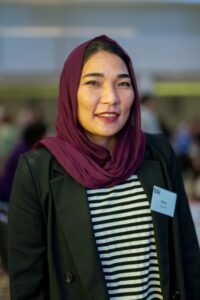
Razia is a distinguished academic and professional, holding two Master’s degrees, a coveted Gold Medal for Academic Excellence, and more than five years of experience working with international organisations. Yet, she is also a refugee from Afghanistan, a status that threatened to overshadow everything she had worked for.
In February 2021, Razia moved to India to pursue her Master’s in Public Administration. Halfway through her degree, the Taliban seized control of Afghanistan, making a return home unsafe.
“I remember those days so vividly. The fear, the sleepless nights, the constant anxiety of not knowing what would happen next. Still, I knew I couldn’t give up,” she said.
Separated from her loved ones and living in limbo, Razia dedicated herself to her studies. She earned a Chevening Scholarship and went on to complete a second Master’s degree at the University of Sheffield.
“Despite having strong qualifications and experience, I found that my refugee status overshadowed my skills,” she said.
“Finding safe and legal pathways to rebuild my professional life felt nearly impossible.”
She wasn’t alone. Across the globe, skilled refugees face a frustrating paradox: highly qualified, yet trapped by legal status and unable to access the professional pathways their credentials should open.
The breakthrough came in 2024 when Razia discovered Talent Beyond Boundaries (TBB), an organisation connecting displaced professionals with migration pathways and employers who recognise their skills.
“For the first time, I felt seen not as a refugee, but as a professional with something to offer,” Razia said.
With support from Talent Beyond Boundaries and partner organisation Migration & Asylum Project (MAP) India, she connected with SSI and received a job offer through Australia’s Skilled Refugee Labour Agreement Pilot – an employer-sponsored skilled migration pathway.
For SSI, Razia’s arrival was a full circle moment.
As long-time collaborators with TBB and advocates for such complementary pathways, directly employing someone through the program they’d championed was profound.
When Razia landed in Australia, she was greeted at the airport by Carmen Ghaly from SSI and Naji Nader from TBB, the two people who walked alongside her throughout the journey.
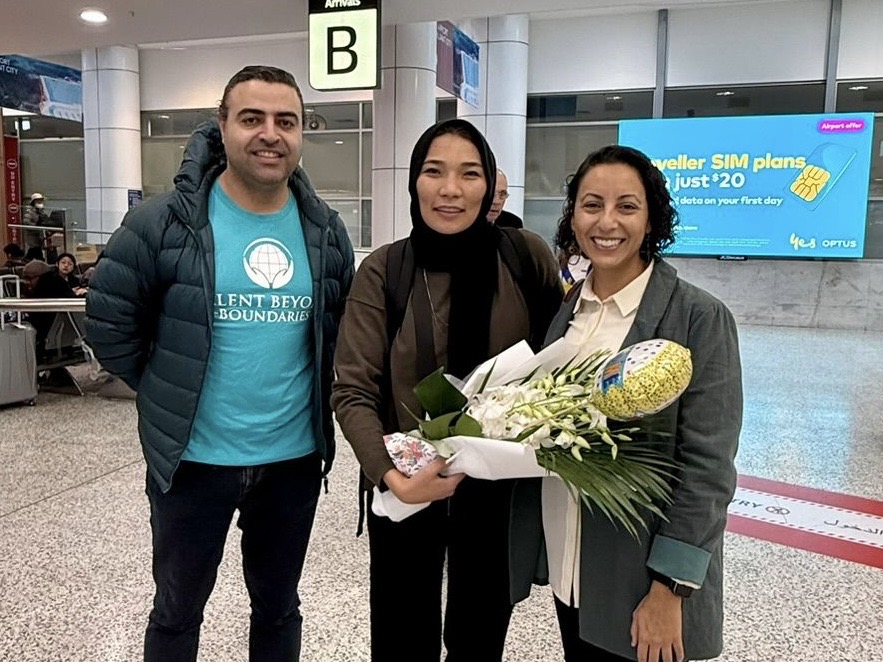
Naji Nader, Razia Muradi, and Carmen Ghaly at Sydney Airport.
“SSI didn’t just offer me a position; they offered me a pathway to rebuild my professional life,” Razia said.
“Their sponsorship made it possible for me to move safely and legally to Australia and restart my career with dignity and confidence.”
After over a year of work, SSI proudly welcomed Razia into a Project Coordinator role in the Bids and Tenders team in 2025. Now, she champions welcome from within the organisation, using her expertise to strengthen the very services that help refugees and migrants rebuild their lives.
“At SSI, I’ve experienced what true inclusion looks like. I was welcomed as a professional, trusted as a colleague, and supported as a newcomer,” she said.
“That’s how change begins when organisations and governments choose inclusion over isolation.”
Amidst multiple humanitarian crises forcing displacement, Razia’s pathway to protection is one that should be celebrated and expanded. The Skilled Refugee Labour Agreement Pilot complements Australia’s humanitarian program – it doesn’t replace it. It creates additional routes to safety outside of Australia’s capped resettlement program for people who might otherwise remain in limbo, their skills unused, and their potential unrealised.
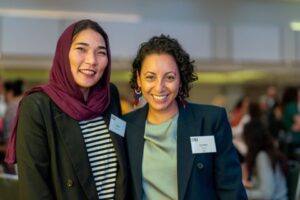
“Policies that create safe, legal, and skill-based migration pathways are not acts of charity. They are smart, compassionate investments. Employers who hire skilled refugees gain team members who bring resilience, adaptability, and deep commitment to their work,” Razia said.
The model is proven. With the pilot ending in June 2026, the opportunity now is to build on its evident success by making the program permanent and expanding its reach. With continued support from government, employers, and advocates, complementary pathways can be a significant and sustainable part of Australia’s migration system.
Razia’s message is clear: “Talent has no borders. When we recognise the skills and humanity of displaced people, we don’t just transform their lives, we strengthen our shared future.”
Learn more about SSI’s international engagement work.