

Food preperation at the Refugee Welcome Centre’s International Women’s Day celebration.
The issues facing women today have been kept front of mind recently with mass women’s rallies across Australia and ongoing reports of inappropriate, disturbing behaviour by our parliamentarians, alongside continued gender pay disparities.
It is a reminder that gender equity is an ideal we have not achieved and must continue to fight for, particularly in the workplace.
With over 70 per cent of SSI’s staff, and a large proportion of our client base, identifying as women, gender equity is cemented at the top of SSI and Access’s priorities.
This year’s International Women’s Day theme of women in leadership is closely aligned with SSI’s Women and Girls Strategic Plan for 2021-2023, which SSI launched on Tuesday.
Leadership and economic empowerment are key pillars of this plan, which aligns with SSI’s three-year Strategic Plan.
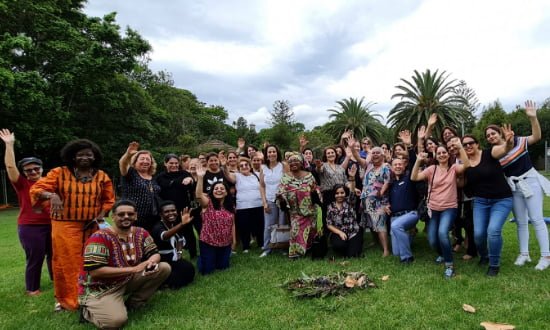
Newly arrived women from refugee backgrounds and volunteers celebrate International Women’s Day.
Our Women and Girls Strategic Plan recognises that SSI works with many talented women who could benefit from targeted strategies and interventions, so that they too can achieve their aspirations.
In developing this strategy, we wanted to properly understand the issues women face in Australia – particularly women from migrant and refugee backgrounds, who account for such a sizable portion of our staff and client group.
We held roundtables with clients and staff to identify these issues. Not surprisingly, the key themes from this included careers, economic security and working conditions.
Our plan recognises that we all have intersectional layers of identity that impact how we experience the world.
It encompasses women of all backgrounds, including transgender women, people who identify as nonbinary, and other diverse genders.
At the launch, SSI CEO Violet Roumeliotis shared that she looks forward to fully embedding the plan’s initiatives, which will improve our society and our organisation, over the next three years and beyond.
“SSI will work with staff and the community to ensure that all our offices and programs are safe spaces, where all staff and clients, regardless of gender identity, feel they have the space and support then need to grow professionally and personally,” she said.
To mark International Women’s Day Violet also attended the 2nd Innate Power of Women Forum, an external event hosted by Lawyers with Solutions, which focused on equipping culturally diverse women with the skills they need to break the ‘professional glass ceiling’ and reach their full potential.
A celebration of the value, contributions, and strength of newly arrived women from refugee and asylum-seeking backgrounds was held last Friday, March 1 at the The Community Refugee Welcome Centre in Lilyfield.
The event, organised by the Humanitarian Settlement Program (HSP) Women’s Committee in partnership with the Inner West Council, kicked off with a smoking ceremony performed by First Nations Elder, Aunty Jenny, and was followed by a welcome to the country, guest speakers, an art exhibition showcase painting by HSP’s client’s, a multicultural dance, food, and tour around Callan Park.
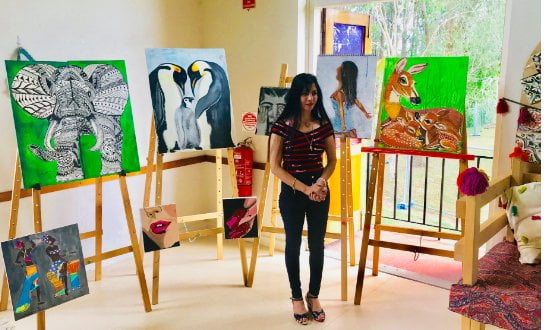 HSP’s client Nawres Abood showcasing her paintings.
It has been really refreshing that both events recognised the unique space that culturally and linguistically diverse women occupy.
We are at the intersection of gender and culture. This gives us a lot of strengths, including a unique perspective. But it also comes with challenges that are beyond those typically discussed at International Women’s Day events.
We know that women from migrant and refugee backgrounds are at the intersection of gender and culture and experience many additional challenges.
For example, the unemployment rate for female migrants is higher than both migrant men and Australian-born women, and one in four women from diverse backgrounds have been forced to scale back at work due to cultural barriers.
A survey SSI conducted in 2020 on the impact of COVID-19 on refugee women highlighted concerns about the economic and social impacts of COVID-19, including job losses in a cohort predominately employed in the hospitality and retail industries.
Employment goes hand-in-hand with financial independence and stability, but the pandemic has highlighted that we cannot segregate newly arrived women to the confines of unstable, low-skilled or low-paid work.
Our efforts to rebuild our society and economy after 2020 must be inclusive. Among other things, we need to enable women and girls from diverse backgrounds to utilise the skills, knowledge, and experience they possess in stable employment with clear career progression opportunities.
In order to fully harness the potential of our population, there needs to be clear career development opportunities for women, in professions they have an interest in. Achieving this not only has benefits for women as individuals and their families, but truly benefits the wider society.
The value and importance of supporting diverse women into leadership positions is just one of the topics I will touch on at the 2nd Innate Power of Women Forum, being held digitally to mark International Women’s Day on March 8.
SSI is also undertaking several initiatives to directly support the needs and advancement of women and girls and ensure they are included in advocacy and awareness campaigns.
This includes SSI’s recently approved submission to the United Nation’s Sixty-fifth session of the Commission on the Status of Women (CSW), which warmly welcomes the Commission’s focus on the full and effective participation of women and girls in decision-making.
SSI, in addition to many other organisations, has responded to the initiative of the Global Refugee-led Network, to endorse the “Refugee Participation Pledge”. This pledge calls on signatories to actively and accountably support the participation of refugees in decisions that affect their lives.
Internally, SSI is taking the time to self-reflect and ask, ‘how can we do better?’ through the implementation of our Women and Girl’s Strategy 2021-2023.
We embarked on developing a Women and Girl’s Strategic Plan in recognition that empowerment of women is an important goal for clients, staff, and multicultural communities.
As a result, we held consultations with women from across the organisation, including several round tables, to hear what our staff want and need from us as an organisation.
Through this process we identified that with an increased focus on wellbeing, leadership and empowerment, SSI can further support our cohort of incredibly talented women to grow professionally and achieve greater professional, financial and social outcomes for themselves and their families.
Our Women and Girl’s strategy will target all women employed and supported by SSI. It will have a particular focus on women from CALD backgrounds due to the significant proportion of our constituency client base they represent.
While crisis may touch all of us, it rarely impacts all demographics equally.
We must be vigilant that COVID-19 and its subsequent effects does not revert progress we have made in closing the gender gap, particularly within multicultural communities, and slow any future advancements to a snail’s pace.
Rather, we must use this upheaval as an opportunity to stop, reflect on, and refocus our work on the areas it is needed most.
SSI CEO, Violet Roumeliotis
bright* client testimonial.
This program was bright*, a two-year initiative based in Darling Square, Sydney, a new urban neighbourhood developed by Lendlease. In 2020, SSI’s small business start-ups program, Ignite, became its delivery partner. The program, which wrapped up earlier this month, was free for budding entrepreneurs or founders of existing businesses who either live, work or study in Darling Square, Ultimo or Haymarket.
Like SSI’s ground-breaking Ignite program, bright* is a Sirolli based program. This methodology is a community-based approach to entrepreneurship, with participants assigned a facilitator who works with the founder on every aspect of the business model in order to form a strong foundation. Facilitators treat every founder and business idea with unconditional positive regard and an eco-system of support is built around the entrepreneur which is drawn from the program’s community-based resource team.
Bright* was able to establish a resource team of 235 skilled local industry experts, business service practitioners, community affiliates and creatives. These people volunteered their time and expertise to assist bright* founders on their entrepreneurial path and provide real world experience and expertise to support founders to overcome any barriers they may be facing in building a successful business.
Bright* was offered free of charge to participants, was not time limited and was completely confidential.
Despite the challenges of the pandemic over the past year, the program made tremendous impact through:
• Over 190 facilitator sessions
• 46 local Darling Square catchment founders becoming clients over the life of the program
• 235 volunteers with broad business expertise
• 5 innovative support programs
On Friday 5 February a final virtual event was held to mark the completion of the program. The event included panel discussion highlighting the views of participants, affiliates, local stakeholders and industry experts around how bright* enabled human connection as well as an abundance of support through a local entrepreneurial ecosystem. As one panellist put it, the program “connected people to the right people”.
SSI CEO Violet Roumeliotis also addressed guests at the event. She commended Lendlease on the initiative and highlighted that it was a wonderful example of collaboration for social and community impact.
“When individuals do well, families do well. Initiatives like this activate people’s passions to live good lives. It is heartening to see the results and the outcomes. It’s extraordinary.”
For more information about bright*, visit www.thinkbright.org.au
“We have all left behind various homelands where someone decided or was forced to leave, crossing the ocean that separates Australia from the rest of the world, by whatever means of transport available, migrated and took refuge on this land and called it home.”- Dr Sanaz Fotouhi, Writer and Filmmaker
Last week marked the conclusion of Motherland – Exile/Refuge – Migration (repeat), a multifaceted exhibition exploring the concepts of migration and displacement, that was displayed at the Australian National Maritime Museum from January 6 to 27, 2021.
The series was the first major initiative between SSI and the Australian National Maritime Museum since the beginning of a flagship partnership between the two organisations, which aims to build awareness of people’s experiences of migration to Australia.
The exhibition brought together a diverse range of artists to explore the many facets and layers of migration through performance art, painted works, sculpture, embroidery, virtual reality, punch needling and more.
Artists in the initiative include the Rohingya Women’s Collective, Sayd Abdali, Hedar Abadi, Carlos Agamez, Maher Al Khoury, Damon Amb, Shivanjani Lal, Nasaphah Nasaphah, Jane Théau and Lynette Wallworth in collaboration with Indigenous Elder Nyarri Nyarri Morgan and Curtis Taylor.
One of the artists, Maher Al Koury, said that he was very proud to be participating in the show, particularly as it was one of his first exhibitions since relocating to Australia and his first at a major cultural institution.
“I want to share my story and my art with the Australian people. I am proud to be doing this work because I want to share my experience and my country, Syria’s, civilisation with Australians. I think this is important because Australia is a peaceful place,” he said.
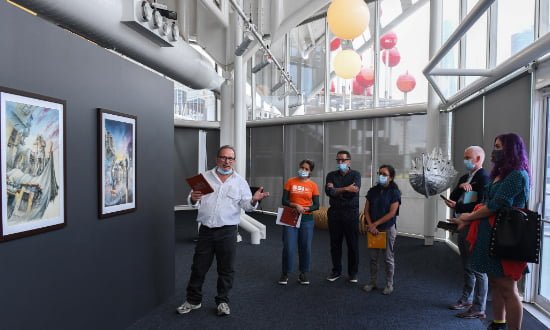
Maher speaking at the Australian Maritime Museum – Photo by Anna Kucera.
Maher Al Khoury arrived in Australia as a refugee from his home in Syria four years ago. He is a visual artist and teacher specialising in painting and drawing. He has been a regular participant in SSI Arts & Culture’s Creative Pathways initiative since 2018.
For Maher, art is an essential part of life—supporting the discovery of self and the exploration of the future. This is especially valuable during times of war, when there is little else to keep hope alive. It is also a vital tool for communicating his story.
“I find it difficult to express myself or describe things and my story in words. I am an artist, so I am far better at expressing [ideas] through my pictures,” Maher said.
His two piece artwork ‘Ground Zero’ was commissioned for the exhibition. It paints a picture of his journey as an artist, losing everything due to the destruction of his homeland and arriving in Australia in search of new memories. His two paintings explore new ways of seeing, the tragic poetry of a life destroyed and visions of hope for a new future for himself and his family.
Maher’s artwork, and the other pieces in the exhibition, encompass rich visual and conceptual approaches to the often-conflicting understandings of migration. We invite you to find out more in the exhibition catalogue.
Over the past 12 months, much has changed in Australia and around the world. Like no other wide-reaching disaster in recent memory, the pandemic has brought many underlying societal issues to the fore, including systemic racism, wealth inequalities, and worrying trends in political leadership around the world.
Within days of the anniversary of COVID-19 arriving in Australia, it was announced that we had surpassed 100 million cases of the virus globally. The practical effect of strong, political and social leadership, which represents the needs and values of the population, is clear.
UK Prime Minister Boris Johnson’s apology for his government’s handling of the pandemic illustrates the boiling point many nations have reached, and the impact political discourse can have on public actions.
Despite several hiccups, Australia has done an incredible job in coming together to reduce the impact of the pandemic on our population. By respecting lockdowns, mask mandates and social distancing, our country has emerged from 2020 with relatively small numbers of COVID-19 community transmissions and deaths.
Our collective cooperation and solidarity have not just been a win for the hard-working medical teams, or government policy, but for all Australians who have put others first over the past 12 months.
For many people living in Western societies, the COVID-19 pandemic was the first time they had experienced an all-encompassing, existential threat to their individual and collective physical, economic, and societal health.
I know for myself, and the people around me, this sense of losing a degree of control over our freedom of movement and general lives because of necessary precautions has taken a toll. Life did not stop, and these stressors were simply layered over our pre-existing responsibilities and challenges.
In times of crisis, where our physical, economic, and mental health is at risk, it is all too easy to blame the other. Many attempt to self-soothe by simplifying and shifting responsibility for the situation we face.
Instead of using division and blame, we can regain a sense of control over our lives by playing a role, no matter how small or large, in the direction of our community and democracy. Connection and individual accountability are important if we want to emerge from the past year a better society than we began.
A cornerstone of SSI’s advocacy since early 2020 has been to look at COVID-19 as a reset button for our society. Not only has the pandemic highlighted hidden and visible inequalities, it has also provided us with the opportunity to change the structures that create them and build back better in our recovery.
As the rollout of the COVID-19 vaccine begins next month, this will be front of mind. Throughout the pandemic, vulnerable communities have at times been overlooked. In the coming months, we will continue to advocate for these communities, to receive fair access to the vaccine.
Actively contributing to the world around us is a fantastic way to break down social barriers, reduce isolation and gain a sense of fulfilment. It is impossible, and in many ways unhealthy, to put pressure on ourselves to be champions for all injustices, but we can take small steps to be the change we want to see in the world.
There are many things you can do to be an active member of your community and our democracy. These include getting to know and spending time with your neighbours, educating yourself on the issues faced in your local government area, attending a town hall meeting, making use of and respecting public spaces, challenging your perspectives through open discussions with people with different views, and leading by example by taking steps to nourish your mental and physical health.
By being active rather than passive members of society and being aware of the motives, struggles and goals of others, we can regain a sense of control and understanding of the world around us.
The COVID-19 pandemic has shown that as a community we can do this. As a collective we have had to work to protect our most vulnerable during the pandemic and push back against divisive, hateful attitudes. Our challenges may not be over, particularly as we explore vaccine distribution, but I am confident that there are positive developments ahead if we all do our part in steering us in the right direction.
Iraqi refugee, Basima Sharwena, attended the online workshops.
Together they delivered an online women’s health and wellbeing program, hosted online September–December 2020 to accommodate COVID-19 health and safety regulations.
The workshops were created to support vulnerable refugee women who were susceptible to experiencing isolation throughout the pandemic.
Yasmin Mohamed, a co-facilitator and representative of LWHC, said the program targeted newly arrived women from different Arabic speaking backgrounds and sought to engage them in activities that raised their awareness about health.
“Conducting the program virtually was a way to facilitate social inclusion for the women, despite COVID-19,” she said.
The workshops, held each Friday, originally only had four participants but quickly grew to 15.
Various topics were covered in the sessions, including Zumba and healthy diets to mental wellbeing, information about TAFE short courses and understanding domestic violence.
Basima Sharwena, a 67-year-old Iraqi refugee who attended the workshops, said they were enjoyable and informative.
“I was interested in the health and healthy food sessions and exercises,” she said.
“I also liked the TAFE and education session, especially when they explained there’s an opportunity for people of all ages to study and complete courses through TAFE.
“I have a degree in Economics in Iraq and I want to continue studying in Australia.”
Danitza Castro, a facilitator from the Tenant Participation and Community Engagement sector of Mission Australia, said the workshops were a success.
“This group had been amazing and shown true growth through the increasing numbers of participants,” she said.
“We saw the increasing confidence of participants using different technology and their growing confidence in learning and being able to access services relevant to their situation.”
Initially, organisers were concerned about the attendees’ ability to access the workshops online.
According to SSI’s ‘Foundations for belonging: A snapshot of newly arrived refugees’ report, 51% of women from refugee backgrounds surveyed reported experiencing difficulties when navigating essential government and online services. Through effective training, the issue was addressed.
SSI Case Manager Parcina Girgis assisted in organising the event and said that the experience increased women’s confidence in using technology.
“We spent long hours in training the women to access the platform and benefit from it.
“It was a great opportunity for our women to learn to use an online platform in the uncertain time of COVID-19.”
Ms Sharwena said that although it was initially challenging, she was able to overcome that barrier.
“It was very difficult for me, in the beginning, to participate in the group online. Now I’ve learned how to do it, I feel very confident to practise and communicate with them.”
Ms Girgis said she was grateful to all those who helped bring the program to fruition, including Ms Mohammed, Ms Castro, the service providers involved, Amer Bahi and the HSP case managers who encouraged the participants to attend (Sajeeda Mehrabi, Amna Khurram, Firoozeh Dorranian, Christine Keogh, Nour Aletah and Cigdem Uydasoglu.)
Diana Hassan has a part-time job at Tassal Tassie Salmon.
The sisters have only been in their new country for a short time, arriving in Australia in August 2019. They sought refuge in Jordan for four years before this, due to Iraq’s political instability.
Diana Hassan is finishing her Certificate 4 in Interior Design at TAFE and has a part-time job at Tassal Tassie Salmon.
Similarly, 22-year-old Sandra Hassan completed a Nursing Assistant Course at TAFE and is employed part-time at Lebanese restaurant, La Mono.
Both sisters are fluent in English, as, during their time in Jordan, they were diligent in acquiring speaking proficiency in the language.
“We couldn’t study or work there (in Jordan), we were just waiting to travel… So I worked on my English language before I came to Australia. Speaking English has made me more confident to do things here,” Diana Hassan said.
Ms Hassan’s ambition and fluent English led to her employment at Tassal, where she works two days a week.
“I actually got this job from the SSI staff, a caseworker. She sent me to see if I’m interested and I said yes because I want to get any work experience I can in Australia.
“I like to try something new… Especially because it’s about seafood and I had no idea what kind of work that is,” she said.
For Ms Hassan, her work at Tassal is more than a source of income. It is enabling her interpersonal and professional skills.
“I’m working under pressure, that’s the biggest skill I’m learning. We have to pack the seafood and measure them to a specific scale. We have to work very fast.
“I can use these skills in a future job: dealing with people, communicating in a new country and working with people from different cultures. I think it’s good for me in my future employment,” she said.
Her younger sister Sandra Hassan, who also has advanced English skills, is succeeding in her new workplace, La Mono, a restaurant her SSI case manager scouted for her in the hospitality industry in November.
“The people there are kind and help me a lot.
“The skills are useful to me. I’m on the cashier, so I’m becoming more comfortable with money. It’s going to become much easier for me to speak with people… To get more confident talking with different people from other cultures,” she said.
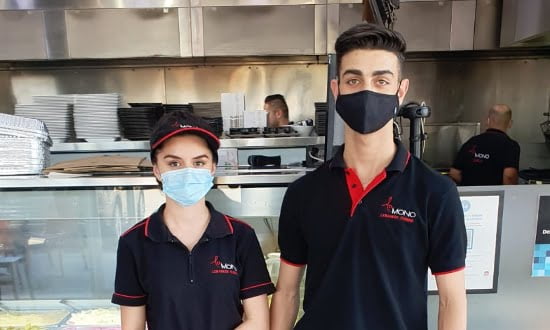
Sandra Hassan is employed part-time at Lebanese restaurant, La Mono.
While the sisters are flourishing in their respective workplaces, they are also enrolled in tertiary education programs to foster their future career plans.
Following a creative pursuit, Diana Hassan is in the final stages of her Certificate 4 in Interior Design at TAFE. She later plans to complete a Diploma in this field, followed by a Bachelor of Arts Degree.
“I found out it’s better to learn new skills at TAFE first, because it’s more practical, especially when learning about software and 3D designs… Once I finish that I will do what I want at university.
“I hope to be an interior designer. After I did my Certificate 4, I got more information about interior design and learnt more details about how I can work in the industry.”
For Sandra Hassan, since completing her Certificate 3 in Nursing Assistance at TAFE, her future career plan is also focused on seeking higher education.
“The first thing I want to do is to keep studying, even if I finish a BA of Nursing, I then went to study more to learn more about it.
“I really like to take care and spend time with people who are old and children. I like to care for people who need and want help. I think nursing is the thing that includes everything I like.”
The duo is showing signs of a successful and dynamic future. Both of the women attributed their early success in Australia to the support of SSI.
“SSI has helped us a lot as a family at the beginning. Everything we want, we just call them, and they answer,” said Sandra Hassan.
“I feel there’s someone or people are behind me supporting me whenever I feel I don’t know where to go,” said Diana Hassan.
*The women’s surname has been changed to protect their anonymity.
*Go to https://homeaffairs.gov.au/ for more information.
People from refugee backgrounds at Western Sydney University learning about local tertiary education pathways.
A multilingual program of workshops was developed by SSI’s Humanitarian Settlement Program (HSP) Orientation Team, with WSU supporting people navigating university enrolment.
WSU’s Widening Participation Engagement Marketing Community Project Officer, Bronwyn Williams, said the workshops were adapted to suit an online format to keep delivering the program when COVID-19 placed restrictions on large face-to-face interactions.
“With young people, the online format works well as this is a demographic that likes to do everything from the comfort of their own home,” she said.
Four workshops had 120 participants from an array of cultural backgrounds, including members from the Arabic, Persian and African communities, who were grouped into language cohorts.
Nihal Al-Rahmani, a 21-year-old Iraqi refugee who is a part of the HSP program, attended a workshop that was translated into Arabic. She said being able to access the tertiary pathways workshop empowered her to study.
“I found it very helpful because most of the information was new to me. I didn’t know I could go to university straight away … I thought I needed to do a certain course before I could enrol. It was great to learn I can go straight to university.”
While there were concerns about hosting the workshops online, participants still gained valuable information.
Solomon Fantahun Wube, a 40-year-old Ethiopian refugee, attended one of the workshops in English. After improving his English speaking skills at TAFE he plans to attend university.
“It was good for me to get information, so now I know what I need to do to go to university,” he said.
Since the workshops finished in October, 10 participants have contacted local universities. The universities accommodate the students’ needs, with support offered from SSI for the entire application process.
Ms Al-Rahmani, who is currently deciding between enrolling into business administration or health science at WSU, said that she found the process valuable.
“At the beginning, I was lost,” she said.
“SSI helped me to do my resume and assisted me to navigate pathways to university. They told me what courses are available, how to enrol, and provided me with information from the orientation and case management team.”
Collaboration on higher education pathways has been part of the collaboration between WSU and SSI since 2017.
In the past, the SSI team would take participants to “Taster Days”, where newly arrived refugees would meet the WSU team and get introduced to the university.
“The WSU and SSI partnership has been in the works for a few years, but this year has been a particularly impressive turnout,” said Dr Alfred Mupenzi, who specialises in refugee communities and is a co-facilitator of the workshops.
He said that program’s outcomes already showed promising results, with a growing demand for more workshops.
“It’s worked very well so far. Everyone has a different journey and we try to capture that with the way we facilitate, both during the workshops and in our follow up communications.”
To get involved, contact, Joudy Lazkany on jlazkany@ssi.org.au.
Roben Noonoo arrived in Australia as a refugee in February 2020.
Now he’s already making plans to establish his family business in his new home.
The Humanitarian Settlement Program, funded by the Australian Government Department of Home Affairs* and delivered by Settlement Services International (SSI), was able to provide Mr Noonoo with a new life after he fled his home in Iraq due to the country’s political instability.
While living in Iraq, Mr Noonoo completed his tertiary studies in media and communications and worked for a cosmetic company.
Steering away from his qualifications, he developed a new passion for business. He went into a partnership with his brother and together they took over their father’s company that specialised in selling dried fruit – specifically dates.
“My father and grandfather all worked in dates. They worked in a traditional way.
“I developed the business by having a food lab where I would be innovative. The dates I sold had things like pistachio and almonds in them.”
Originally the dates were sold from a small shop at the local markets. Through Mr Noonoo’s development of the business, they started selling their dates to upscale stores and online.
“I created a brand for myself. I was well-known with a good reputation.”
With a deep sense of pride and an unwavering ambition for the survival of his company, Mr Noonoo plans to restart his business in Australia with the support of SSI’s Ignite® program.
“I had this dream even before coming to Australia. At SSI they have a division that can help you when you have a business idea. “I got in contact with them and am starting to understand and research what I can do to make this happen.”
“I got in contact with them and am starting to understand and research what I can do to make this happen.”
He has dedicated an extensive amount of time to researching the date market in Australia, attending fruit markets to understand their prices, distribution, quality and competitors.
“SSI Ignite has been amazed I’ve collected so much information about the market in a short space of time,” Mr Noonoo said.
As Mr Noonoo is still settling into his new life and his business idea is in its infancy, he is currently focusing on learning English at TAFE and getting his licence.
He has found SSI to be an important support system during his settlement journey.
“They (SSI) really want people to stand up on their own feet. They have given me so much, and now I want to give back to Australia.”
With exciting plans on the horizon, Mr Noonoo is optimistic about his future.
“There are challenges to adapting to a new country, but if you have a dream and vision, nothing is impossible.”
*Go to https://homeaffairs.gov.au/ for more information.
Finding Your Feet (detail) by Sayd Abdali, Nasaphah Nasaphah and Jane Theau for Motherland-Exile/Refuge-Migration (repeat) Exhibition, January 2020, Australian National Maritime Museum.

Without doubt, this year was not what any of us expected. And it’s safe to say for many of us, 2020 gave the word unprecedented a new definition.
In this year alone, we have survived unprecedented fires, an unprecedented pandemic, and unprecedented restrictions.
But, if I had to choose one word to define this year for us, or for the communities we support, I would choose resilience.
While it has been a difficult year, there have also been wonderful moments of optimism, like our bushfire communities rebuilding, COVID-19 restrictions easing, and our communities rallying together despite physical and social isolation.
Time and time again over this year, we have seen our clients demonstrate incredible resilience and ingenuity in the face of adversity.
Despite many individuals being in the midst of their settlement journey, they have worked tirelessly to not only keep their family on their feet in the wake of social and economic disruption, but have also come together to support the wider community.
The power and empathy of our communities are a constant inspiration.
Furthermore, the resilience of our staff and partner organisations, and the unwavering commitment to our clients and communities is something I am immensely proud of.
To have survived this year as an organisation is a credit to our hard-working staff.
Our staff have come through this year with resilience, compassion, and dedication. While they themselves have been affected by the pandemic, they have proudly continued to deliver quality services to our clients and communities.
In all the years of SSI’s operation, we have faced many tests of resilience. This year has been incredibly challenging, but I know we will again emerge with strength, integrity, and, most importantly, we will emerge together.
I think it is important to acknowledge that although it has been a difficult year, we have also made some amazing achievements.
In 2020, we proudly celebrated 20 years of serving and advocating for our communities at SSI. We provided crisis support to individuals and families from asylum seeker backgrounds through donated food packages.
We also continued our journey to provide disability support services to multicultural communities as we commenced providing the NDIS Local Area Coordination Service.
We extended our Multicultural Foster Care Program into Victoria and have recently been selected to deliver a multicultural service to address gambling harm across Victoria.
While these are only some of our achievements, this wouldn’t have been possible without support from our staff, the community, our member organisations, funders, and other partners in the community, corporate and academic sectors. Thank you.
For me, this year has served as a crucial reminder of why SSI and Access exist and why we have been proudly advocating and supporting our clients and communities for the past 20 years.
Our newly released 2019-2020 Annual Report shows that, over the course of a single year, SSI staff made a positive difference in the lives of over 37,400 people.
Thank you all for your continued help in supporting newcomers and other vulnerable community members to reach their full potential.
I also want to acknowledge that this year, many people may be spending this time away from family.
It’s why I want to encourage you, in the spirit of the season, to reach out to people who may be on their own, such as those on temporary visa holders, or people who are socially isolated, like your friends and neighbours, to check in and offer them some company.
I hope you all have a wonderful and safe holiday break.
Violet Roumeliotis
SSI CEO