

In recent years, a significant portion of refugees who come to Australia have originated from Middle Eastern countries such as Iraq, Syria and Iran. But Australia also offers refuge to people closer to home, with significant numbers of people coming from Myanmar, Bhutan and Tibet, like Tsering.
Myanmar, in particular, is a major source country for refugees, accounting for 1.1 million of 26 million refugees around the world in 2020. It is also one of the most high-profile examples of displacement in our region due to the ongoing persecution of the Rohingya and Karen minorities. This focus has only increased with the recent military coup.
Twenty-six-year-old mother Sajeda Bahadurmia was among an earlier exodus of Rohingya people in 2013, when she and her husband boarded a boat with their children and came to Australia to seek asylum. SSI supported Sajeda through her initial settlement, and she has gone on to volunteer with newly arrived individuals and families and advocate on behalf of her own community.
But Myanmar is one of many countries in our region that is on the international radar due to the displacement of its people. The situation is also uncertain in China, where concerns are growing over the treatment of the Uyghur minority and residents of Hong Kong, particularly those involved in the pro-democracy movement.
Australia has a track record of coming to the aid of our neighbours. The most historic examples of this are former prime minister Bob Hawke’s live-to-air offer of asylum to some 42,000 Chinese nationals at the time of the Tiananmen Square massacre. He followed in the footsteps of former prime minister Malcom Fraser, who opened the door to more than 50,000 Vietnamese people following the fall of Saigon.
Already, our federal government has created a pathway for about 10,000 Hong Kong citizens studying or working in Australia to extend their visas for at least five years. While a blanket extension has not been offered to Myanmar nationals, our government has reassured visa holders that they won’t be returned to Myanmar when their visas expire.
As a signatory to the UN Refugee Convention, Australia has an obligation to extend certain rights to people who receive refugee status due to war or persecution. These ‘rights’ include the right not to be returned to persecution.
This principle of non-refoulement is a foundational element of the UN Convention, and one that should underpin all countries’ approaches to refugees within their territories and countries.
At SSI, these obligations are front of our minds as we engage with our peers internationally to gain a global perspective on, and contribute to, international dialogue on refugee and migration issues.
SSI is linked to advocacy efforts in the Asia-Pacific region as an organisational partner of the Asia-Pacific Refugee Rights Network (APRRN). Our APRRN partners, such as Fortify Rights, have called on the international community for immediate and collective action to end the Myanmar junta’s widespread and systematic killing of unarmed people.
In the meantime, we must do all that is within our power to safeguard the welfare of residents of these countries who are on Australian shores and ensure we live up to Australia’s legacy as a safe haven for people fleeing war and persecution.
Bevan and his LAC Coordinator.
While managing the ups and downs of early adult life, Bevan also must navigate the world as an individual living with Asperger Syndrome.
Bevan receives a National Disability Insurance Scheme (NDIS) plan that he utilises to support him in managing his mental and physical health.
Accessing the NDIS is a process which often involves complex paperwork. Now, with the support of his SSI Local Area Coordinator (LAC) Planner, Indu Pandey, Bevan can focus less on the paperwork and more on getting the most out of life.
In 2009 Bevan was diagnosed with Asperger Syndrome, a learning which he describes as ‘completely changing his life.’
“I found the NDIS in 2017 and started receiving support from the LAC shortly after. It has really helped me manage my disability in both my personal and public life and overcome obstacles I never thought I would overcome at first,” said Bevan.
Throughout his life Bevan has lived with both the challenges, and benefits of an Asperger’s diagnosis. Growing up, one of his greatest challenges was the social aspect of school life.
“I was a bit of an outcast at school and sometimes did things that made people a bit uncomfortable, but I didn’t really understand how or why I made them uncomfortable,” said Bevan.
Around this time, his teachers and medical professionals also noticed his incredible ability to retain information and identified him as having a photographic memory.
“I found out that I had a photographic memory when I was finishing primary school and my teachers and psychologists noticed it. My memory helps me with my studies and everyday life because I can remember important details. “
Bevan is currently in his third year of a Bachelor of Science, Majoring in Mathematics, at UTS. He hopes to continue his education and specialise his skills in the coming years.
“I would like to do some document analysis, which involves analysing documents to see if there are any inconsistencies or forgeries.”
Much like his earlier years, Bevan’s greatest challenges are found in social interactions and connecting with other people.
“Anxiety, agitation, and controlling my temper are challenges. It can be hard because sometimes my parents don’t even understand me. It kind of makes me nervous because I would like to become a husband or father one day, but I worry that I may not be the right person for the job because of my condition,” said Bevan.
Now, with the support Bevan is receiving through his NDIS plan and the coordination and support provided by his LAC planner, Bevan is finding it easier to connect with others.
“Socialising used to be the hardest part of living with Asperger’s, but not as much now. I have started going to social events more,” he said.
With the support of SSI’s LAC program and his therapist, Bevan has joined a local social group for young people living with disabilities. He explained that he now frequently attends events such as music festivals, going to restaurants or just meeting up to chat.
Accom News | Published: Friday, 09 April 2021
In 2020, as COVID-19 was turning the world upside-down, eight artists embarked on an immersive and artistic professional development program exploring their refugee experiences. Their goal: to maximise opportunities within the Australian arts sector, where their voices had been generally neglected and unheard.
Education today | Published: Thursday, 25 March 2021
Attendance at early childhood education makes a difference for the development of all children but children from diverse backgrounds are less likely to go.
These children continue to be more likely to be developmentally vulnerable at school entry than children from non-CALD backgrounds in each census since 2009, but that the gap has narrowed over time.
The Wire | Published: Friday, 09 April 2021
A media commentary yesterday indicated that culture is a risk factor of youth incarceration, referring to the overrepresentation of the African youth in Victoria’s criminal system. Community organisations like Settlement Services International are pledging the media to be more careful with their comments, as migrants are more susceptible of being discriminated thanks to the disinformation on the media.
Western Sydney University | Published: Wednesday, 31 March 2021
Western Sydney University is helping refugees and asylum seekers learn about opportunities for further study, through a new partnership with Settlement Services International. The University, with support from several student ambassadors, has contributed to a multilingual program of workshops developed by Settlement Services International and delivered online.
Subculture Media | Published: Wednesday, 07 April 2021
Fan Force have announced the cinema release of Rosemary’s Way, the feature documentary that has charmed audiences at Festivals around the world. Rosemary’s Way celebrates the remarkable Rosemary Kariuki, 2021 Australian of the Year – Local Hero, and the group of vulnerable migrant women of suburban Sydney whose lives she helps transform from isolation to connection.
Refugee Tsering Yangozam with the 14th Dalai Lama of Tibet.
The Humanitarian Settlement Program, funded by the Australian Government Department of Home Affairs* and delivered by Settlement Services International, has provided Ms Yangzom with wrap-around support services since she arrived.
As with many refugees, the move to Australia has been jarring for Ms Yangzom, who is adapting to a new life.
“At first, it was very difficult. We came to Australia, and everything was new, including the culture. I felt like it was me and the sky.”
With the initial challenges of resettlement behind her, Ms Yangzom was supported by SSI to use her multilingual skills to assist the local Tibetan refugee community.
Ms Yangzom’s case manager noticed her stellar English skills and recommended she work for SSI’s ethnic inter-practice team, where she has been able to translate from Tibetan to English.
“At first, it was a little bit challenging because I don’t have much experience interpreting things. Later on, I learned how to, through my own research on the Internet.
“In future, I want to continue to improve my English so I can help more in the community. But at the moment, it’s a side job because with my studies I can’t do this full time.”
Ms Yangzom is studying for a Certificate 3 in Aged Care and Community Services. She was drawn to the course because it will give her the opportunity to support vulnerable people.
“I chose this course because, as a Tibetan, we are taught the importance of family. I spent my life alone for 25 years without my family so, in that way, I understand and want to help others.”
Her eagerness to be of service to the community reflects Ms Yangzom’s history working for a non-government organisation (NGO) and, later, in politics.
In India, she completed her diploma in Secretarial Practice, which led her to work for six years for the Tibetan Women’s Association, the second-largest Tibetan NGO.
Seeking new challenges and experiences, she then worked for four years for the National Democratic Party of Tibet, a major party in the Tibetan government in exile.
“The executive members (of the party) approved me to become an executive member and, through an election, I became the general secretary.
“I had to organise workshops, meetings with different people and leadership training for Tibetan students in Indian universities. I also had to act in place of the president when he was not in the office, which was a big responsibility.”
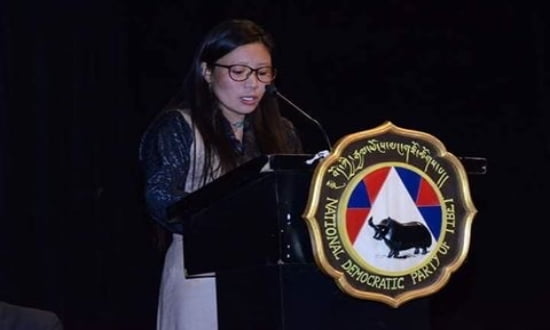
Tsering Yangznom worked for four years for the National Democratic Party of Tibet.
For Ms Yangzom, this exciting career offered her a strong connection to her Tibetan identity and enabled her to meet people from all walks of life.
“I was able to talk to other Tibetan people and exchanged ideas and experiences. We belong to each other and could exchange our culture with each other, as well as with different people.
“Western people would visit the centre, and we could talk with them, share our lives with them, political backgrounds and stories. They would do the same, and it became a wonderful platform to learn so much more than I expected.”
Ms Yangzom’s political background provided a strong foundation for her to flourish in her future endeavours, as seen in her achievements in the short time she has lived in Australia.
While she is in the early stages of her resettlement journey, Ms Yangzom is grateful for the opportunity to live in Australia and is already making social contributions in community.
Ms Yangzom said that she was grateful for the Australian government and SSI, which she said consisted of reliable people she could trust.
“When we look back on this from a historical perspective, we will remember that Australia has politically supported Tibetan people in exile. Because of this, as an individual, and in my future, I will always try to give back.”
*Go to https://homeaffairs.gov.au/ for more information.
The Hamdi Hesari family arrived in Australia in April 2019.
Through the Australian Government’s Humanitarian Settlement Program (HSP), Service Settlement International (SSI) provided the Hamdi Hesari family with wrap-around support services in their new home.
The Hamdi Hesari family were forced to flee Iran in 2015 as they are members of the Baha’i faith, a persecuted minority group in Iran. They temporarily relocated to Turkey for three years, where they waited for their Australian visas to be approved.
Ms Hamdi Hesari said that as refugees in Turkey, they were not eligible to work and were met with significant financial problems.
“None would offer us help or support. Then suddenly, a door opened for us, and we were able to come to Australia on the humanitarian refugee visa.”
Relocating to Australia was met with enthusiasm, but the move negatively impacted Ms Hamdi Hesari’s, now 7-year-old son, Noyan Hamdi Hesari, who lives with autism and found it disruptive to his learning and social development.
“My son was three years old when we got his diagnosis of autism. It was a very hard situation because we couldn’t find therapy sessions. They were too expensive, in a different language, and the Turkish government didn’t support us,” Ms Hamdi Hesari said.
“We (my husband Farid Hamdi Hesari and I) spent a lot of time researching and doing our own work to find ways to support him. Progress in autism is very slow, and it was very hard. We put all of our energy into him, but we didn’t see good results.”
Since they arrived in Australia, HSP has provided Ms Hamdi Hesari and her son with support and advocacy with relevant service providers, including arranging appointments with GPs and specialists.
SSI assisted Ms Hamdi Hesari’s son gain access to the National Disability Insurance Scheme (NDIS) by referring him to another service provider. He is now enrolled in an educational program tailored for children living with autism.
“It’s really important he goes to school five days a week. Our lives have completely changed, and I’ve seen improvements in him. It’s very gradual, slow. But we can see some changes.
“Because my son was in different countries, with different languages, his progress has been slower than other children. But now, after one-and-half years in therapy and new schooling, we can see some growth.”
For the Hamdi Hesari family, being confident that their child is being educated and looked after by people equipped to support him, they have newfound freedom and flexibility in their lives.
“We are happy our son is in a school where he has a good relationship with his teacher who cares about him. It’s such a relief.
“As parents, we can now study, work and do other activities. It’s very good for our mental health.”
Ms Hamdi Hesari recently finished her Certificate IV in Allied Health Assistance at Kingswood TAFE, and Mr Hamdi Hesari is now enrolled in a building constructions course.
Another extra-curricular engagement now available to Ms Hamdi Hesari has been workshops that explore employment and social life in Australia. She also attended the Callum Park Mother’s Day celebration, where she could socialise with people from diverse cultural backgrounds.
The Hamdi Hesari family is continuing to improve their English and have future ambitions to secure employment that can work around their son’s needs.
“I’m really happy in Australia, and it’s a great country. The government support has helped us reach a new level of independence.
“I hope this can happen for our friends that are in Turkey at the moment so that they can restart their lives here.”
Despite great international interest in the first years of the conflict, coverage of the war has waned in the past few years.
This is a far cry from 2015, when the Australian government joined with other humanitarian leaders in announcing the resettlement of an additional 15,000 people displaced by the conflict in Syria and Iraq. This meant that SSI resettled 10,000 refugees in a single year. It was a huge feat that required collaboration between government, civil society and corporate organisations.
Thousands of everyday Australians also put up their hands, asking, “What can I do to welcome my new neighbours?” Refugees from that intake are now well on the way to successful settlement ― forging friendships, engaging in education, starting businesses ― making economic, social and cultural contributions to their new homes
Research has demonstrated that people from refugee backgrounds have a strong commitment and motivation to fulfil their social and civic responsibilities in Australia. This is seen through high rates of volunteering and community participation.
One of these individuals is Nohara Odicho, who arrived in Australia as a refugee with her father in 2015 and has since channeled her lived experience as a refugee to help others in similar circumstances.
Nohara went on to manage the Community Legal Education program at Legal Aid Refugee Services, responsible for educating refugees about the free services to which they are entitled. In acknowledgement of her work, she was awarded the STARTTS’ NSW Humanitarian Award for a Refugee Community Worker in 2019.
Like Nohara, George Najarian threw himself into community minded work after settling in Australia. George is an award-winning Armenian refugee who was forced to flee Syria.
He has educated thousands of Australian community members about refugees, raised more than $12,000 and launched two scholarships for refugees.
In 2020, the UN estimated that 13.1 million Syrian people like Nohara and George need humanitarian assistance. This equals the population of NSWS and Queensland combined.
If Syria does not find the resources to rebuild, this humanitarian crisis will only persist.
Australia has an obligation as a responsible global citizen to support individuals and families fleeing war and persecution. And we have so much to gain from doing so.
Take Sophie Bejok as an example:
Sophie had been in Australia for six months when she applied for SSI’s Community Innovation Fund to run community cooking classes to help other women integrate into the community. Before the COVID-19 outbreak limited her services, Sophie also ran her own Dance Fit classes and business in the Sydney area.
Economic modelling from Deloitte Access Economics suggests that increasing Australia’s humanitarian migration could increase the size of the Australian economy by $37.7 billion over the next 50 years.
Like Nohara, George and Sophie, many refugees bring with them an entrepreneurial, innovative spirit and hardworking attitude that is often attributed to a blend of their innate character and the hardship they have faced and survived. These qualities are what Australia needs to rebuild as we exit the COVID-19 crisis.
As we prepare to work towards opening our International borders, and allowing migrants into the country, it is paramount that humanitarian protection visa holders are prioritised in their entry, alongside international students. It is both a moral obligation and economic and social imperative.