

Doctors prepare the Pfizer vaccine before it is administered.
In just our first day of operation, approximately 40 community members seeking asylum in Australia received the Pfizer vaccine and has an optional consultation with the on-site doctor.
Western Sydney Local Health District, with the support of SSI and NSW Refugee Health, will continue to provide vaccinations out of the Parramatta office for approximately the next six weeks.
Yamamah Agha, General Manager Service Delivery – Settlement, received her own vaccination alongside community members and reiterated the value in the government collaborating with community organisations such as SSI.
“By running this initiative out of a familiar location and providing in-language support through trusted staff, we have been able to support vulnerable community members to feel comfortable taking the vaccine,” said Yamamah.
“I got the vaccine to show our clients there is no harm in this and that, in fact, it is a way of fighting the spread of the COVID-19 virus. The only way to eliminate the risk and the impact of the pandemic is to become immune, and the only safe way to do this to to get the vaccine.”
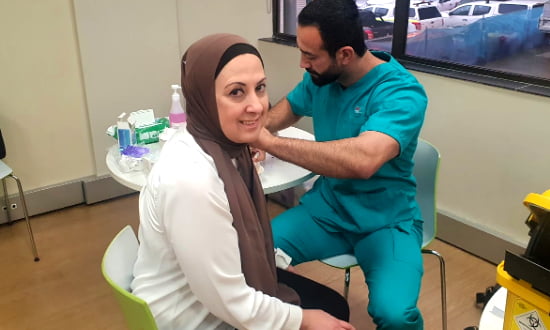
Yamamah receiving her first shot of the COVID-19 vaccine.
Thanga Chandramoulieswaran, an SSI case worker, was one of several bilingual staff and translators who supported individuals through the vaccine process last Thursday.
She shared that several of the people seeking asylum who attended vaccine appointments had additional medical conditions they had to consider when receiving the vaccine.
One of these people, Aayansh* has multiple medical concerns, including a serious heart condition. As a result, he had reasonable medical questions and was in two minds about whether he would get the vaccine.
“In preparation for his appointment, Aayansh was asked to get a medical report and bring all of his medications. Before his appointment, he had a consultation with the on-site doctor who was able to answer all his questions and give him informed advice about the safety and importance of getting the vaccine,” said Ms Chandramoulieswaran
“This gave him confidence and he agreed to get the vaccine. He was very well supported throughout the process and is doing well.”.
Individuals from asylum seeking backgrounds face several social determinates, such as limited access to in-language information, limited medical services, and food and housing insecurity, that can increase their risk of being negatively affected by COVID-19 and other viruses.
So, the preventive measure of receiving in-language information on, and access to, the COVID-19 vaccine is highly beneficial for these individuals, their communities, and consequently the wider Australian community.
If you are from an asylum-seeking background and want to learn more, contact our Parramatta office on (02) 9685 0100.
If you have questions around the COVID-19 vaccine or virus, visit SSI’s in-language community platform here: https://covid19.ssi.org.au/
*Pseudonym used to protect the individual’s privacy.
A&C Products is an organic range selling homemade products by Syrian refugee Ashod Paloulian.
When he first arrived in Australia, Mr Paloulian connected with Tennis Australia through SSI Ignite® Small Business Start-ups. Over the past few years, he has built up his tennis coaching business, Shooting Star Tennis, offering tennis lessons and coaching to people of all ages across Sydney.
He also offered free coaching lessons to refugees, as he knows the importance of community and connection, particularly for new arrivals.
However, tennis coaching is not the only string in Mr Paloulian’s bow. In 2018 he launched a second business, A&S Products, selling homemade organic products at his local markets.
“My father had lots of businesses,” Mr Paloulian said.
“He believed you should never put all your eggs in one basket”.
The family grew up on a farm, so Mr Paloulian was involved in bee-keeping, drying fruits, and roasting nuts from a young age.
The A&S range includes organic fruit, nuts, condiments, homemade organic apple cider vinegar and honey. A&S has built up a strong and loyal following over the past couple of years, and their very first product – pomegranate molasses – continues to be one of the best sellers, thanks to its rich, tangy syrup and medicinal properties.
Mr Paloulian began selling his products at the markets. Then when the COVID-19 pandemic started in 2020 and markets began to close down, he decided to launch a website so his customers could purchase his products online, which he did with the assistance of SSI Ignite®.
“At Christmas, we missed three markets [due to COVID-19 restrictions],” he said.
“We lost a lot of money, and our customers were disappointed that they had to source those foods elsewhere. It doesn’t taste as fresh or as good from the supermarkets.”
With two businesses to run and a family to care for, time is precious, but Mr Paloulian says he somehow manages to make it all work.
“It’s down to good time management, skills and trusting yourself,” he said. His wife helps run the businesses with him, and their young children are involved too.
“We talk about business at home – we talk about everything as a family – so the children are growing up around that,” he said.
“Every day me and my family, in the afternoon, we sit and talk about what we did in the day and what we will do tomorrow. What are the good things we’ve achieved and what we can do better the next day?”
The children like to taste test the products, make suggestions for packaging, and sometimes recruit friends for tennis coaching.
When asked whether he thinks his children will follow in his footsteps as entrepreneurs, he said with a smile, “You will have to ask them that.”
“By the time they are older, everything will be set up for them, but I’ve told them if you want to have a successful business, you need to think big, work hard and fight for it every day.”
Click here to visit A&S Products.
Visual artist and Iraqi refugee Raneen Shamon.
Ms Shamon said that she was no stranger to displacement. Before moving to Jordan, she had already experienced internal displacement in Iraq due to the persecution of Iraqi Christians by terrorism.
“At age two, I was displaced within Iraq, and by age ten, we were displaced a second time,” she said.
“And by the time I was fourteen and displaced for the third time in 2014 because of ISIS who entered Iraq and colonised three cities, we moved to Jordan for immigration process, and I was no stranger to this experience.”
Ms Shamon said that life in Jordan was challenging because they had not anticipated that obtaining their humanitarian visas would take four years as they had valid cause for their application.
“We didn’t think it would take long because we had already suffered a lot.”
Ms Shamon said that although she missed one full year of school in Jordan, it was during this time that she had the opportunity to practice her artistic skills.
“I stayed without school for one year, but during this year, I spent my time focused on art.”
The Shamon family were greeted by Settlement Services International (SSI) at the airport, who provided them with settlement support services on arrival.
“When we first arrived, we stayed at my mum’s uncle’s house in Granville, and we then moved to Mt Druitt.”
When asked to comment on her first few years in Australia, Ms Shamon said that when she had started at the Evans Intensive English School in Blacktown, it soon became evident to her teachers that she was proficient enough in English and recommended that she attend high school.
“They told me I could finish high school and should start year 11 at St Bishoy in Mt Druitt,” she said.
“I enjoyed the Evans school and did lots of painting while I was there; I also designed the cover of the yearly magazine in 2017.”
After graduating from high school with a ‘Dux’ – an accreditation only awarded to one student per year as recognition of outstanding academic performance – she was offered a scholarship to start her tertiary studies at the University of Sydney.
“I am now studying at uni of Sydney and in my second year of my Bachelor of Visual Arts degree.
“I do painting and charcoal, and I’m exploring installation art.”
Ms Shamon said that she was connected to SSI’s Arts and Culture program in 2019 and was mentored through its Creative Pathway and Artist Development Program, which, through a suite of workshops and networking opportunities, provided her with supports on how to develop herself as an artist in Australia.
“They helped me with my exhibition at Blacktown Arts Centre and mentored me on how to find opportunities as an artist in Australia.
“SSI also supported with art supplies by giving me a voucher to purchase my own supplies.”
When asked about her future aspirations, Ms Shamon said she’d like to take an expansive approach to her work as an artist, including facilitating workshops, exhibitions and curating works herself.
“In future, after I finish my studies, I want to have my own academy of art, run workshops, and work as an art curator.
“For now, I have four upcoming exhibitions from June until August, and I’m also running workshops.”
Click here to view Ms Shamon’s Instagram and find out more about her artworks and upcoming exhibitions.
Refugee and artist Maher Al Koury. Photo credits: Anna Kucera.
Settlement Services International (SSI) curated “Motherland – Exile/Refuge – Migration (repeat)”, an exhibition presented in partnership with ANMM, January 6–26, 2021, which included Mr Al Khory’s most recent work “Ground Zero”.
Mr Al Khoury said that he was very proud to be participating in the show, particularly as it was one of his first exhibitions since relocating to Australia and his first at a major cultural institution.
“I want to share my story and my art with Australian people. I am proud to be doing this work because I want to share my experience and my country, Syria’s, civilisation with Australians. I think this is important because Australia is a peaceful place,” he said.
As a visual artist and teacher specialising in painting and drawing, he has been a regular participant in SSI Arts & Culture’s Creative Pathways initiative since 2018.
For Mr Al Khoury, art is an essential part of life—supporting the discovery of self and the exploration of the future. This is especially valuable during times of war when there is little else to keep hope alive. It is also a vital tool for communicating his story.
“I find it difficult to express myself or describe things and my story in words. I am an artist, so I am far better at expressing [ideas] through my pictures,” Mr Al Khoury said.
His recent work commissioned for this exhibition, “Ground Zero”, tells the story of his journey as an artist losing everything due to the destruction of his homeland and arriving in Australia in search of visions of hope for a new future for himself and his family.
“War not only destroys cities and towns and objects of beauty, war defaces humanity. The effects of war can leave a person feeling empty. Art is a way out of that emptiness,” he said.
As a professional artist, Maher challenges himself to see things anew, to allow objects and subjects that appeal to him to take on identities that throw a different light on how they are perceived. He is interested in the interplay between ‘reality’ and ‘illusion’.
Mr Al Khoury’s artwork and the other pieces in the exhibition encompass rich visual and conceptual approaches to the often-conflicting understandings of migration.
You can peruse Mr Khoury’s work in the exhibition catalogue here.
As a part of this commitment, we are proud to have introduced new Cultural and Wellbeing Leave to our workforce. This initiatives gives staff access to up to three days of paid leave in order to honour days of cultural significance and take care of their wellbeing.
Importantly, as a part of our work towards developing our Reconciliation Action Plan, Aboriginal and Torres Strait Islander staff are being provided five days of Cultural and Wellbeing leave per year.
The allocation of additional days of leave for Aboriginal and Torres Strait Islander staff is in line with our reconciliation commitment to shape a pathway where everyone has an opportunity to prosper.
Our end goal is to contribute to the best of our ability to an Australia that steps out in courage to build a unified, equal and respectful nation.
The theme for National Reconciliation Week 2021 is ‘More than a word. Reconciliation takes action,’ and it highlights how we all have a vital role to play when it comes to reconciliation, both as an organisation and as individuals.
You can read a list of 20 suggested actions, developed by Reconciliation Australia, you can take to walk with First Nations communities here.
Although only a small gesture, we hope this change is an indication of the SSI Group’s eagerness to put our words into action in walking with First Nations Communities. This is just one part of the action we are taking to help achieve reconciliation in Australia.
No matter who we are or what our background is, we all have a role to play when it comes to reconciliation. Only by stepping up and playing our part can Australians collectively build relationships and communities that value Aboriginal and Torres Strait Islander peoples, their histories, cultures, and futures.
Refugee Janet Ferdosian has transformed her life while being the sole carer for her son and mother.
Ms Ferdosian was granted a visa to come to Australia with her son and mother in November 2017.
“In Australia, there are a lot of people that want to help and support you. I received specialised support from SSI and especially Firoozeh, my case manager.
“At first, I was really confused about the rules in this country. I wasn’t sure how I could make it a safe place for my kid, which was my main priority. SSI really helped me.”
Ms Ferdosian is from the Baha’i faith, a marginalised minority group in Iran that has been subjected to persecution and systemic gender inequality issues. Despite socio-political challenges, and since in Australia, she has impressively transformed her life while being the sole carer for her son and mother.
“I’m stronger and more powerful. Thanks to both the government and myself. I improved my language, career and my story.
“I’m planning to be a strong mother. I’m trying to do my best.”
Ms Ferdosian has become fluent in English and completed a Certificate 3 of business administration at TAFE. Back in 2018, she also studied for a Diploma in Business at Western Sydney University.
She has volunteered at SydWest Multicultural Services in Blacktown and received her Certificate 3 at TAFE to become a Disability Support Worker.
Her most recent achievement is securing casual employment in the disability sector with Afea Care Services, where she will work as a care support worker.
“While studying to be a support worker, I realised the people I would care for have similar past experiences and challenges in life to me.”
Ms Ferdosian said that she could relate to others’ experiences when she sees them improving day-to-day and achieving their goals.
“They need support to achieves their goals, and maybe like me, they want to improve their abilities and be a part of society.
“That’s really amazing and something I wanted for myself my first day in this country.”
While Ms Ferdosian has been able to channel her lived experiences and resilience to succeed in her new life, she sees her main accomplishment as providing a life of safety and security for her son.
“My son was facing a really hard situation that was inappropriate for a kid at that age. In Australia, we feel valued and respected, and every need my son has is covered.
“His soul is calmer; he’s relaxed here. There’s no danger anymore. He’s really successful in school, and now, I’m hopeful about his future.”
Jessy began receiving support from the NDIS in 2016 and first contacted her Local Area Coordinator (LAC) in late 2019 seeking guidance around employment, and assistance with day-to-day tasks and management of NDIS funds.
At the time, Jessy was experiencing workplace bullying. To assist her in overcoming this situation, Jessy’s SSI Information, Linkage and Capacity Building (ILC) Consultant put her in touch with a legal representative who talked her through her rights and what she could do to seek help in the future.
“I liked my work, but felt I got in trouble for things that I didn’t do. It made me angry,” said Jessy.
Soon after, with the support of a Disability Employment Services provider and ILC Consultant, Jessy found a new job with a smaller property realtor, where she now feels more supported and included.
Jessy’s employer has been making ongoing efforts to support her in the role and has rostered Jessy to allow her to pursue studying computer skills at TAFE while working part-time.
“I like my new workplace better because when I ask someone a question or for help, they don’t walk away from me. There is more teamwork at a small office, and I think teamwork is very important for everyone,” she said.
With the support from her LAC in managing funds in her NDIS plan, Jessy started receiving support from a speech pathologist to assist her communication skills and has also started seeing a counsellor for psychological support.
Her LAC, Esther Chan said Jessy has now moved out of her family home to live independently and enjoys playing an active role in reviewing and accessing the services she receives.
“Jessy had been living with her parents for more than 20 years. Now, she has become more independent and confident by living in her own home,” she said.
“Jessy made her own choice to choose a provider that suits her, and she negotiated and discussed with providers by herself. We try to empower and encourage her independence as she is a high-functioning young lady.”
Jessy plans to continue her computer literacy studies and hopes to one day apply them to a full-time job.
“I am a hard worker. I really am normal, just like everyone else”, she said.
I have felt one step closer to answering that question through my work on the University of Sydney’s Open Society, Common Purpose taskforce over the past six or so months.
Last week, the taskforce shared the fruits of this labour – a report setting out a roadmap for how Australia can return to its position as an outward-looking country with a robust market economy that generates inclusive prosperity.
The reports calls for a staged process of international re-engagement based on three public health pillars:
- widespread and rapid vaccination backed by measures to increase public confidence,
- rigorous border testing and immunity requirements for incoming travellers, and
- scaled up quarantine designed to meet the needs of specific industries.
In last week’s 2021-22 federal budget, we heard that the current limits on international arrivals to Australia will remain in place until 2022.
Contrary to rhetoric about Australia’s ‘hard border’, our state and federal governments have actually safely enabled some 500,000 people to travel into Australia since COVID-19 arrived in Australia last year.
In the three months between the COVID-19 public health emergency beginning in January 2020 and Australia’s border closing to non-residents in March, SSI itself welcomed many refugees to our shores.
Our settlement practices ensured the safety of the humanitarian arrivals and the community, and minimised risks to both groups, while also ensuring refugees had the support to get on with the important work of settling in their new homes.
The past 15-odd months have acted as a kind of testing period; these necessary border restrictions have bought our country time to establish robust quarantine, testing and tracing protocols that have prevented mass outbreaks. The question now should be how do we expand that process. How do we ensure we prioritise Australian citizens and the 6,500 refugees who currently hold Australian visas but are unable to travel here due to restrictions on non-resident arrivals?
In the meantime, I am heartened by the incredible outcomes this cross-sector taskforce has produced, supported by the University of Sydney’s Policy Lab and participants who gave up their time for three roundtables earlier in the year.
With this kind of bipartisan collaboration, I am confident Australia will emerge from this pandemic as an outward-looking country with a generous, sustainable immigration program and a robust market economy that generates inclusive prosperity.
Ghassan Noujaim, SSI’s Senior Operation Manager – QIP, Multicultural Child and Family Program, says children develop and thrive in the context of relationships, community, faith and culture.
“It is best practice that all children and young people in care are connected to their family, to know the reasons they come into care and to help with the sense of belonging where they feel proud to fit in, which is going to be the first step in their healing journey,” he says.
For teens, this might seem more challenging as young people can often have some pretty strong opinions — including about family. Teens might say family isn’t important, but often change their minds when they become adults.
“It is important to link a young person with at least one family member who they can call when needed and build connection and feel safe,” advises Mr Noujaim.
An essential strength of human evolution has been our ability to establish and maintain our capacity to belong. Richard Rose’s extensive Life Story Work has explored the notion of our “biologically powerful need to belong”, be that to “clan, community or culture”. Our ability to draw upon our connection with people of our past, will help shape our hopes and dreams for a safe and connected future.
Life Story Work intends to ensure that children and young people have an accurate record of their family background and history.
“SSI developed its life story resource, My Life and Me, to improve cultural responsive work with children and young people from Culturally and Linguistically Diverse (CALD) backgrounds,” explains Mr Noujaim.
“A key part of this background and history is information about the child or young person’s cultural and religious heritage. This includes information about their birth parents’ culture, ethnicity, religion, language, and life in their country of origin. It should also include information about the child’s relationship to their cultural and religious heritage.”
“Life Story Work is collaborative and centred around the child’s needs. Different people will be able to provide different things at different times.”
For more information about becoming a foster carer with SSI, please contact us:
For NSW:
P: 1800 960 976
E: fostercare@ssi.org.au
For Victoria:
P: 1800 955 774
E: vicfostercare@ssi.org.au
W: multiculturalfostercare.ssi.org.au
Irfan Nasiri is the first person in his family to go to university.
The Nasiri family are Hazara, an ethnic minority originally from Afghanistan, who had moved to Pakistan in the mid-nineties seeking security as life was becoming increasingly unsafe for Hazaras in Afghanistan.
“People started migrating because Afghanistan became less safe for the Hazara people,” Mr Nasiri said.
Although Pakistan was safer than Afghanistan had been, it became challenging for the Hazara community to live there over time.
“The Hazara community was targeted, and life was tough.” Mr Nasiri’s father had arrived in Australia in 2010 by boat, after deciding to risk his life for the long-term safety of his family.
“My dad took the decision to search for security. First and foremost, safety and then, a better place to live.”
“As we were part of the Hazara community, we heard about the success of Hazara reaching Australia safely, and that’s what motivated our family to take this risk.”
When asking Mr Nasiri what it was like for his family to be separated from his father, he said it had been difficult, but as a sixteen-old, his young mind didn’t think too deeply about it.
“Back then, I didn’t pay too much attention, but now that I am twenty-three, I can’t even imagine what it was like for my mum thinking about my dad coming over here by boat.
“They were determined to keep us safe, and there was positivity in their decision.”
Mr Nasiri recalls waiting to hear from his father when he left Pakistan on his treacherous journey to Australia and hearing from him when he reached the shores of Indonesia.
“We had to wait, and it wasn’t quick. I remember my dad used to talk to us, and he was in contact when he reached Indonesia.”
Once Mr Nasiri’s father arrived in Australia, they began planning for the family’s future and reuniting in Australia. “I remember my father used to tell us that life won’t be easy here and that we need to start preparing ourselves.
“He encouraged us to learn English in Pakistan because he faced many language barriers in Australia. So, we went to English language institutions.
“I think it really helped. I could feel a difference to his experience when we arrived in Australia, as I had already learnt some English.”
Although Mr Nasiri has come far on his journey and succeeding on many fronts, including studying finance and economics at Western Sydney University, he said resettlement presents many challenges.
“When I arrived, I remember that at first, I would not go out of the house because I thought I’d get lost in a new country and life.
“It’s harder for my mum, as she doesn’t know English. She can’t understand, and the language barrier is a challenge.
“For example, even catching public transport is difficult for her. Understanding which bus takes you to which suburb, all of these daily tasks are much harder for my mum.”
Mr Nasiri is connected to refugee support agency Settlement Services International (SSI) through the NSW Settlement Partnership (NSP) and its partner, Accessible Diversity Services Initiative (ADSI), who supported him with preparing his Year 12 scholarship application.
“My refugee transitional advisor at Chester Hill High School suggested I attend the ADSI educational sessions offered at my school. “My aim was to go to uni after high school, and these educational workshops were very helpful.
“I am grateful for the refugee support services here in Australia and the programs and supports they offer.”
After finding numbers interesting in high school, Mr Nasiri knew at his core that he would pursue finance at university and said that despite his family not being university educated, they admired and valued his drive.
“I’m the first in my family to go to university, and I consider it one of my biggest achievements. My family value this even though they aren’t educated.”